
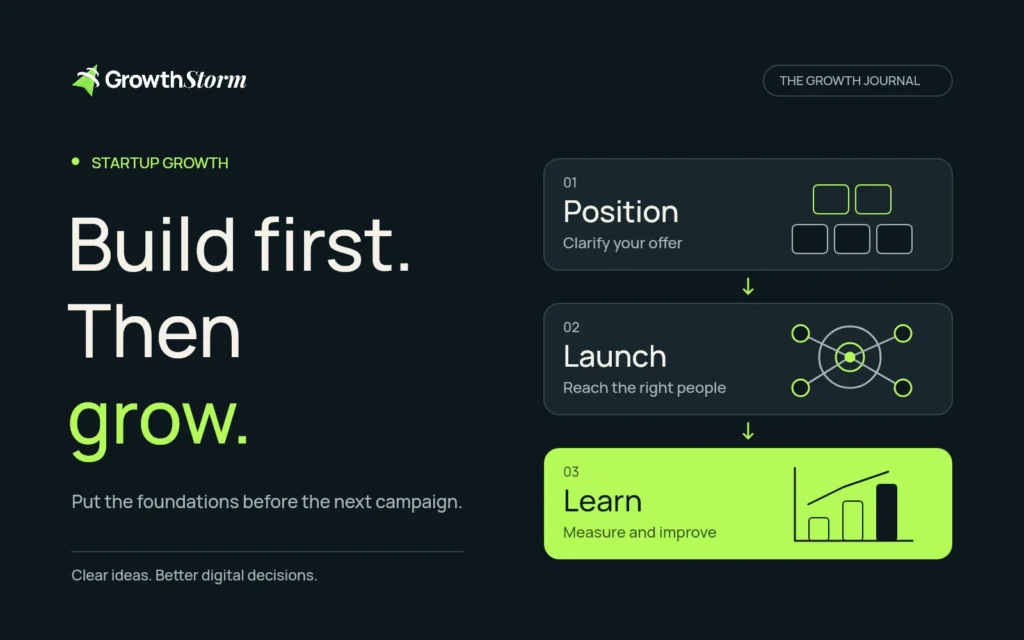
Digital marketing for startups in Pakistan works better when the offer, website and measurement are ready before you try to scale.
That makes marketing prioritisation more important — not less.
The goal is not to launch on every channel as quickly as possible.
It is to find the smallest marketing system that can answer the next important business question.
Can people understand the offer?
Can we reach the right audience?
Will they take action?
Can we measure what happened?
Can we repeat what works?
This framework helps Pakistani startups think about digital growth in that order.
Start With Positioning
Before choosing Google, Meta, SEO or influencers, answer:
- Who is this for?
- What problem does it solve?
- Why should the customer choose it?
- What does the customer need to believe before acting?
- What is the next step?
Weak positioning makes every channel more expensive because the campaign has to explain a confusing offer.
Build A Credible Digital Foundation
A startup does not always need a large website.
It does need a credible destination.
At minimum, the customer should be able to understand:
- What the company does.
- Who it helps.
- How the product/service works.
- Why it can be trusted.
- How to buy, join, book or contact.
For early-stage startups, clarity is usually more valuable than unnecessary website complexity.
Choose The Channel Around Intent
Useful when people already search for the solution.
Useful when the product or offer can create demand through strong creative.
Useful when commercial/informational search demand can compound over time.
Useful when the startup serves customers in specific physical locations.
Useful selectively for higher-value B2B opportunities.
Useful when the customer needs education or trust before buying.
Do not start with five channels because a marketing plan template listed five channels.
Test The Offer Before Scaling The Budget
Paid media can reveal:
- Which message earns attention.
- Which search terms indicate demand.
- Which audience responds.
- Which landing page converts better.
- Which objections appear repeatedly.
But a campaign cannot fix a weak offer indefinitely.
If the market is not responding, the correct move may be:
- Change the positioning.
- Change the offer.
- Change the landing experience.
- Improve trust.
- Narrow the audience.
- Pause the channel.
Measure The Right Stage
An early startup may not have enough data to optimise for final revenue immediately.
Use the best meaningful signal available.
Examples:
- Signup.
- Demo.
- Qualified lead.
- Trial.
- Purchase.
- Repeat purchase.
- Booked consultation.
Avoid celebrating metrics that do not answer a business question.
Impressions without action are visibility.
Clicks without conversion are traffic.
Leads without qualification are volume.
Do Not Ignore Follow-Up
For service or B2B startups, growth may break after the lead arrives.
Ask:
- Who receives the enquiry?
- How quickly?
- What happens if they do not answer?
- Is follow-up recorded?
- Can marketing learn whether the lead was useful?
A simple CRM process can create more value than adding another acquisition channel.
Build Organic Assets While Paid Media Learns
Paid campaigns can create faster feedback.
SEO and content can build assets over time.
A startup with limited resources should prioritise content that supports:
- Commercial search intent.
- Sales objections.
- Product/service education.
- Comparison and decision questions.
- Internal links to important landing pages.
Do not publish content simply to keep a blog “active.”
A Practical Stage-By-Stage Model
Stage 1 — Foundation
- Positioning.
- Basic brand.
- Credible website/landing page.
- Tracking.
- Clear conversion.
Stage 2 — First Demand
- One primary acquisition channel.
- Controlled budget.
- Simple creative.
- Lead/purchase feedback.
Stage 3 — Improve Conversion
- Landing pages.
- Offer.
- Sales/follow-up.
- Measurement.
Stage 4 — Build Compounding Visibility
- SEO.
- Content.
- Local search where relevant.
- Lifecycle email/CRM.
Stage 5 — Expand
- Second paid channel.
- More creative.
- More locations.
- Automation.
- Broader reporting.
Move stages because the next bottleneck is clear — not because time passed.
Common Startup Marketing Mistakes
- Launching too many channels at once.
- Building a large website before the offer is clear.
- Optimising for cheap leads instead of useful ones.
- Ignoring sales follow-up.
- Creating content without search intent.
- Scaling spend before tracking works.
- Confusing brand awareness with customer acquisition.
- Buying tools before the team has a process.
How Much Should A Startup Spend?
There is no universal percentage or magic number.
Budget depends on:
- Customer value.
- Margin.
- Sales cycle.
- Demand.
- Competition.
- Stage.
- Runway.
- How quickly the startup needs to learn.
A useful rule is simpler:
Spend enough to get meaningful feedback from the chosen channel without risking the business.
If the budget is too small to test five channels properly, test one.
THE TAKEAWAY
Conclusion
Digital marketing can give startups speed, feedback and reach.
But growth does not come from switching on every platform.
It comes from making one part of the system work, learning from it, and earning the reason to add the next part.
Start with the bottleneck.
Then make the next move count.