
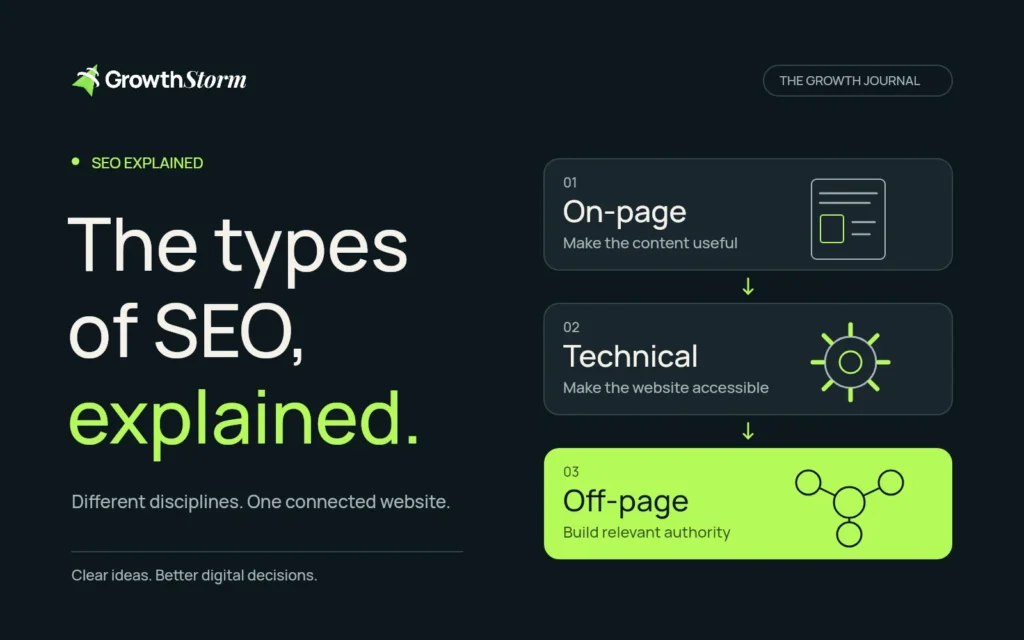
SEO is not one task.
Improving a page title, fixing crawl problems, building local visibility and earning relevant mentions are all SEO — but they solve different problems.
Understanding the main types of SEO makes it easier to diagnose what your website actually needs instead of treating “SEO” as one vague monthly activity.
On-Page SEO
On-page SEO covers the elements on a webpage that help users and search engines understand its topic and purpose.
This can include:
- Page title.
- H1 and headings.
- Body content.
- Search intent.
- Internal links.
- Image context.
- Meta description.
- URL structure.
- Calls to action.
Good on-page SEO is not about repeating a keyword as many times as possible.
It is about making the page the clearest, most relevant answer it can be for the search intent it owns.
When it matters:
- A page exists but does not clearly match the query.
- Several pages are competing for the same keyword.
- The content is thin, confusing or poorly structured.
Technical SEO
Technical SEO focuses on whether search engines can access, crawl, understand and index the site properly.
Typical areas include:
- Crawlability.
- Indexation.
- XML sitemaps.
- Robots directives.
- Canonical tags.
- Redirects.
- Broken links.
- Site architecture.
- Core performance issues.
- Mobile usability.
- Structured data where appropriate.
Technical SEO does not replace good content.
It removes barriers that can stop good content from performing properly.
When it matters:
- Pages are not indexing.
- A migration changed URLs.
- The website is slow or unstable.
- Duplicate versions exist.
- Search engines are crawling the wrong pages.
- The site architecture is difficult to understand.
Content SEO
Content SEO focuses on creating or improving pages that answer real search intent.
This can include:
- Commercial service pages.
- Product/category pages.
- Buying guides.
- Educational articles.
- Comparison content.
- FAQs.
- Industry pages.
The important part is page purpose.
An informational article should not compete with a commercial service page for the same job.
When it matters:
- The site lacks pages for important search demand.
- Existing content is outdated or weak.
- Search Console shows impressions for topics the site does not answer well.
Off-Page SEO & Authority
Off-page SEO covers signals beyond your own website that can contribute to authority, reputation and discovery.
This can include:
- Relevant backlinks.
- Digital PR.
- Industry mentions.
- Citations.
- Partnership mentions.
- Useful resources people choose to reference.
Not every backlink is useful.
Volume alone is not the strategy.
Relevance, credibility and risk matter.
When it matters:
- The site has good pages but little external authority.
- Competitors consistently earn stronger mentions and links.
- The business has real expertise/assets that could attract references.
Local SEO
Local SEO focuses on searches where location strongly influences the result.
It connects:
- Google Business Profile.
- Google Maps.
- Local landing pages.
- Reviews.
- Business information.
- Local relevance.
- Website SEO.
Google explains that local results are primarily based on relevance, distance and prominence.
When it matters:
- Customers choose a nearby provider.
- The business has a physical location or legitimate service area.
- Google Maps is part of the buying journey.
Ecommerce SEO
Ecommerce SEO applies SEO principles to stores where product and category architecture create additional complexity.
Typical areas:
- Category/collection pages.
- Product pages.
- Faceted navigation.
- Duplicate/filter URLs.
- Product structured data.
- Internal linking.
- Out-of-stock handling.
- Search intent around products and categories.
When it matters:
- The store has many products.
- Categories are poorly structured.
- Product pages are thin.
- The site creates large numbers of duplicate/filter URLs.
International SEO
International SEO becomes relevant when the site deliberately targets customers across different countries or languages.
It may involve:
- Country/language architecture.
- hreflang.
- Localised content.
- Currency/market context.
- Search-intent differences by region.
It is not necessary simply because a website can technically be viewed worldwide.
Which Type Of SEO Do You Need?
You may need more than one.
Examples:
Local SEO + on-page SEO + technical foundations.
Technical + ecommerce + content + authority.
Commercial on-page SEO + content + technical + authority.
Architecture + technical foundations + keyword mapping first.
Technical SEO and redirect/indexation review first.
The priority should follow the bottleneck.
What SEO Is Not
SEO is not:
- Keyword stuffing.
- Buying random backlinks.
- Publishing hundreds of thin AI pages.
- Creating fake locations.
- Guaranteed #1 rankings.
- A one-time plugin setup.
SEO is an ongoing process of making the website easier to crawl, more relevant to useful searches and more credible over time.
THE TAKEAWAY
Conclusion
The most important question is not:
“Which type of SEO is best?”
It is:
“Which part of our search system is currently limiting visibility?”
Once that is clear, the work becomes easier to prioritise.