
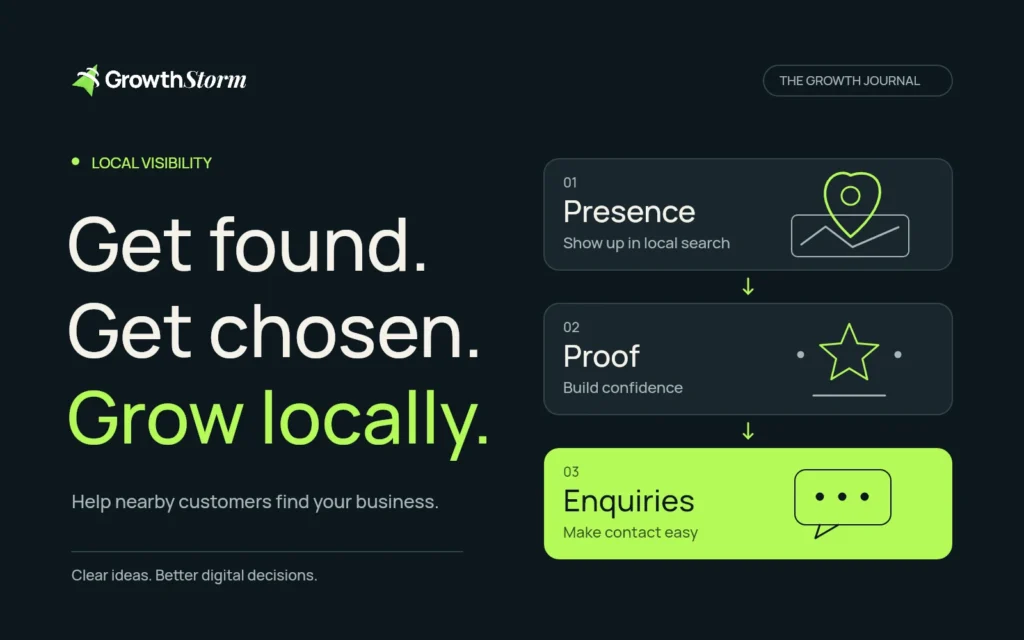
This local SEO strategy for Pakistani businesses connects Google Business Profile, local pages, reviews and clear business information.
Local SEO is the work of making that local presence clearer, more accurate and more relevant.
It is not a trick for forcing a business into the Map Pack.
Google publicly explains that local results are primarily influenced by relevance, distance and prominence. A business can improve the information and signals it controls, but it cannot pay Google for a better organic local ranking or guarantee a specific position.
Start With An Accurate Google Business Profile
Your Google Business Profile should accurately represent the real business.
Check:
- Business name.
- Primary and secondary categories.
- Address or service-area setup.
- Phone number.
- Opening hours.
- Website URL.
- Services/products where relevant.
- Photos.
- Business description.
- Attributes available for the category.
Do not add keywords to the business name unless they are genuinely part of the real-world business name.
Accuracy is more important than trying to manipulate the listing.
Understand Local Search Intent
A useful local keyword strategy begins with how customers search.
Examples can include:
- service + city
- service + neighbourhood
- service near me
- best / nearby / open now style intent
- brand + location
- problem + location
The purpose is not to repeat city names everywhere.
It is to understand which services have genuine location intent and make sure the website has useful pages that answer those searches.
Build Useful Service And Location Pages
A local landing page should help a real customer.
It may need:
- The service being offered.
- The area genuinely served.
- What makes the business relevant there.
- Contact details.
- Maps/location information where appropriate.
- FAQs.
- Approved proof.
- A clear call, WhatsApp, booking or enquiry action.
Avoid producing dozens of nearly identical city pages with only the location name changed.
Thin duplication creates a poor user experience and weakens the quality of the site.
Keep Business Information Consistent
Customers should not find different phone numbers, addresses or business names depending on where they look.
Keep important business information consistent across:
- Website.
- Google Business Profile.
- Relevant directories.
- Major social profiles.
- Industry listings where useful.
Small punctuation differences are not the real strategy.
The goal is accurate, trustworthy business information across the places customers and search engines encounter it.
Reviews Should Be Real
Reviews can influence customer trust and are one of the signals Google discusses in relation to local prominence.
Build a legitimate review-request process.
Good practice:
- Ask real customers for honest feedback.
- Make the review link easy to access.
- Respond professionally.
- Learn from repeated complaints.
- Keep the process consistent.
Do not:
- Buy reviews.
- Offer incentives in exchange for reviews.
- Create fake accounts.
- Ask staff/friends to fabricate customer experiences.
Google’s policies prohibit fake and incentivised review manipulation.
Use Real Photos And Useful Profile Content
Photos help customers understand the business before they visit or contact it.
Depending on the business, useful images may include:
- Exterior.
- Interior.
- Team.
- Products.
- Completed projects.
- Facilities.
- Menu/items.
- Real service environment.
The goal is credibility, not uploading images merely to “feed the algorithm.”
Google Business Profile updates can also be useful for customers when the business has real news, offers or information to share.
The Website Still Matters
Local SEO is not only a Google Business Profile task.
The website helps explain:
- What the business does.
- Where it operates.
- Which services are available.
- Why the customer should choose it.
- How to take the next step.
Broader SEO foundations — crawlability, useful pages, internal links and site quality — support local visibility too.
Mobile Conversion Matters
Many local searches happen close to the moment of action.
Make it easy to:
- Call.
- WhatsApp.
- Get directions.
- Book.
- Request a quote.
- Submit a simple form.
A visitor should not have to search through the site to find the phone number or location.
Build Local Prominence Naturally
Prominence is broader than directory submissions.
Useful signals can come from:
- Relevant local/industry coverage.
- Real partnerships.
- Community involvement.
- Industry associations.
- Useful local content.
- Links and mentions from credible websites.
- Reviews and customer activity.
Do not buy low-quality directory or backlink packages solely to create volume.
Measure The Actions That Matter
Track what the business can act on.
That may include:
- Organic local landing-page traffic.
- Google Business Profile interactions.
- Calls.
- Website forms.
- WhatsApp clicks.
- Directions.
- Bookings.
- Qualified enquiries.
Rankings are useful diagnostic signals.
They are not the only measure of whether Local SEO is helping the business.
A Simple Local SEO Checklist
- 1. Verify the Business Profile.
- 2. Confirm accurate business information.
- 3. Choose the correct categories.
- 4. Add useful services, photos and details.
- 5. Map real local search intent.
- 6. Improve the most important service/location pages.
- 7. Make mobile actions obvious.
- 8. Create a legitimate review process.
- 9. Keep important business information consistent.
- 10. Monitor visibility and meaningful enquiries.
THE TAKEAWAY
Conclusion
Local SEO works best when the online presence accurately reflects a real, useful local business.
There is no legitimate shortcut to a guaranteed Maps position.
Focus on the factors you can influence:
- Relevance.
- Accurate information.
- Useful local pages.
- Trust.
- Prominence.
- A strong website.
- A clear conversion path.